Geotek Instruments Corporate Website
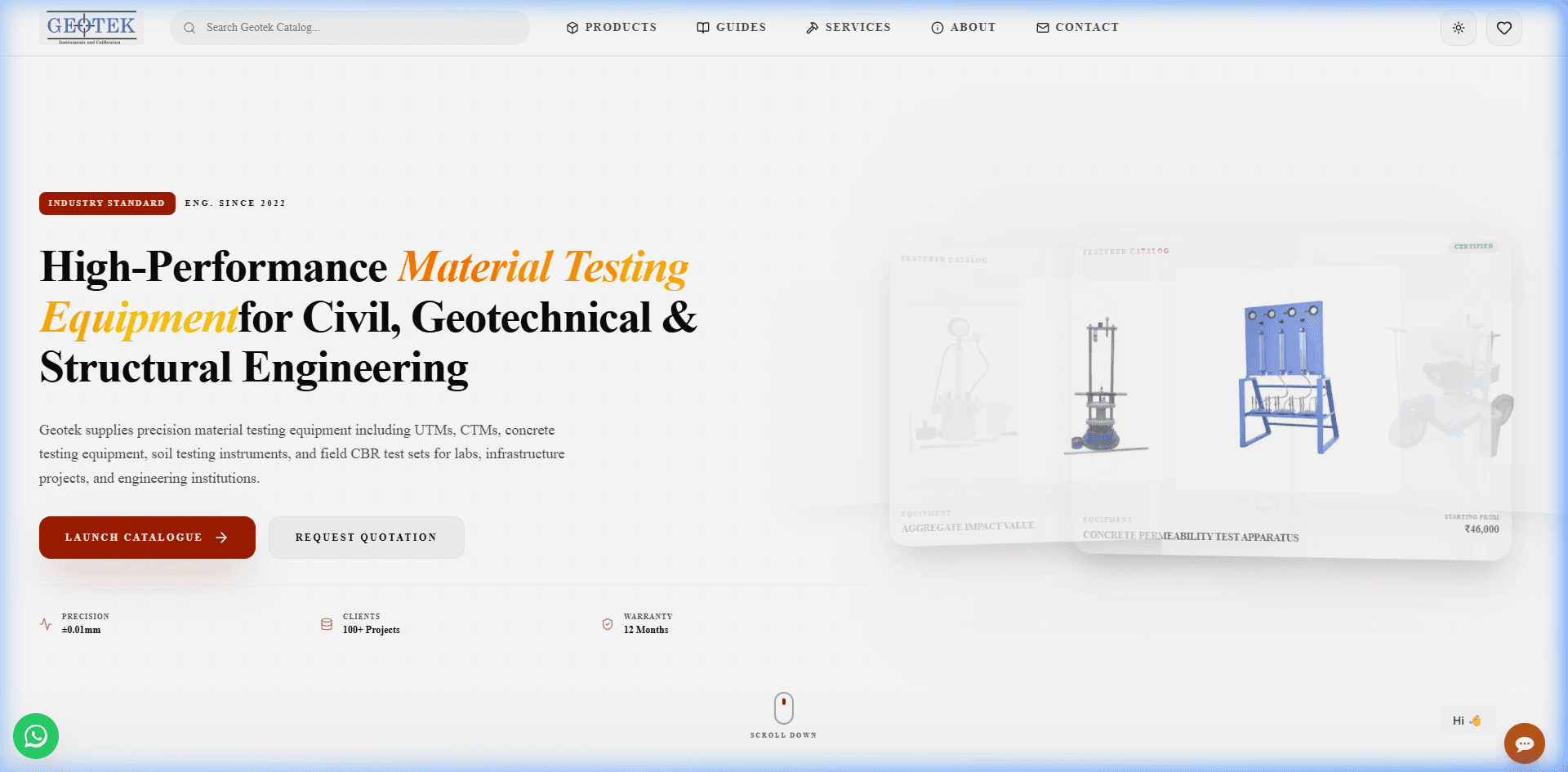
A modern corporate website and product catalog for Geotek Instruments, a manufacturer of soil and material testing equipment, integrated seamlessly with Odoo ERP.
Project Overview
Geotek Instruments is an established manufacturer and global supplier of high-precision soil, rock, and material testing equipment. They needed a high-performance digital storefront and technical catalog to showcase specialized testing apparatus to geotechnical engineering firms, research institutes, and university laboratories worldwide.
The Challenge
Before this initiative, technical specifications and catalogs were primarily maintained through physical print binders and static PDF downloads. This created substantial operational bottlenecks:
- Sales Cycle Friction: Potential clients frequently referenced out-of-date technical data sheets when submitting RFQs (Requests for Quotation).
- Complex Hierarchical Taxonomy: The equipment catalog spanned dozens of sub-disciplines—from Rock Mechanics and Advanced Soil Dynamics to Asphalt, Cement, and Aggregate Testing—demanding intuitive multi-level navigation.
- Convention Traffic Spikes: International trade expos generated severe concurrency spikes that bogged down their legacy hosting server.
- B2B Inquiries vs. Consumer Cart: Engineers don't add 500-pound triaxial testing frames to a standard shopping cart; they require structured inquiry workflows with custom parameter inputs.
The Architectural Solution
We designed and delivered a modern, headless architecture combining a Next.js App Router frontend with an Odoo 16 ERP backend for unified catalog and lead management.
Headless Odoo ERP Integration
Instead of routing public visitors directly to the ERP, we decoupled the presentation tier completely. The Next.js frontend interacts with Odoo's XML-RPC service via secured internal endpoints. Catalog data is pre-rendered at build time with on-demand Incremental Static Regeneration (ISR), providing near-instant page transitions while shielding the internal database from external load.
// Production pattern: Decoupled catalog query with Odoo XML-RPC
export async function getInstrumentDetails(productSlug: string) {
  const odoo = createOdooRpcClient({
    url: env.ODOO_RPC_ENDPOINT,
    db: env.ODOO_DATABASE,
    uid: env.ODOO_USER_ID,
    apiKey: env.ODOO_API_KEY,
  });

  const [product] = await odoo.executeKw('product.template', 'search_read', [
    [['website_slug', '=', productSlug]],
    ['id', 'name', 'technical_specs', 'standard_codes', 'datasheet_pdf']
  ]);

  return product;
}
Edge Caching and Performance Architecture
- Global Edge Delivery: Pre-rendered HTML routes cache across edge POPs, driving Time to First Byte (TTFB) down to approximately 80ms globally.
- Spec Sheet & PDF Delivery: CAD schematics, high-resolution equipment renders, and technical manuals stream with aggressive caching headers.
- Containerized Infrastructure: The frontend and reverse proxies run in isolated Docker containers behind Nginx on a dedicated Linux VPS with automated SSL certificate renewal.
Implementation Milestones
- Information Architecture & Wireframes: Structured 300+ instruments into a dual-axis catalog navigable by testing standard (ASTM, AASHTO, BS) or material category.
- Headless Odoo Bridge: Established automated synchronization between Odoo ERP inventory records and frontend static generation triggers.
- Design System & Accessible UI: Implemented clean, high-contrast Tailwind CSS styling engineered for readability across engineering lab workstations and mobile devices.
- CI/CD Pipeline: Configured GitHub Actions workflows executing linting, TypeScript verification, Docker container builds, and zero-downtime deployment cutover.
Verified Production Outcomes
- 95+ Google Lighthouse Score: Consistently achieves sub-second Largest Contentful Paint (LCP) and zero Cumulative Layout Shift across all catalog views.
- 99.9% Uptime Reliability: Sustained heavy concurrent traffic surges during major civil engineering expos without performance degradation.
- Streamlined RFQ Pipeline: Inquiries route straight into the client's Odoo CRM pipeline, cutting lead response times by more than half.
Planning a similar infrastructure migration?
Get a comprehensive architecture review and fixed-cost execution plan.
Explore More Case Studies
Innovative Solutions Platform
High-performance digital platform and equipment catalog for an authorized Leica Geosystems dealer specializing in surveying instruments and 3D laser scanners.
CMS Modernization & Hardened InfrastructurePrimetek Industrial Web Portal
Comprehensive digital portal redesign and server security overhaul for an industrial machinery and spare parts provider, converting legacy architecture into an automated lead machine.